A big part of what we do at ripplecreate is to run larger scale coding programs for students at MOE schools, international schools and other organisations. Earlier in March this year, we were given the opportunity to curate and run a coding program for the lower primary students of Queeenstown Primary School.
The main aim of the program was to introduce students to the fundamentals of coding and computational thinking. Due to the relatively young age of the students, we curated a program and utilised a screenless robotic platform that will help students develop their cognitive abilities and pick up important coding concepts.
Topics covered included:
- Fundamentals of Coding
- Logical Sequencing of code
- Iteration
- Debugging
By the end of the program, students were able to pick up the fundamentals of coding and understand the approaches used in tackling the associated challenges. I.e. identifying a problem, thinking of a solution to the problem and testing the solution.
The content curated for Primary 1 and Primary 2 differentiated in terms of the theme and the level of difficulty for the challenges. Running this program with Queenstown Primary for the second year, the current Primary 2 students were able to catch on to the lesson faster as many of them remembered how to use the robot and were fast with the functionalities.
Imparting 21st Century Skills
Integrating Queenstown School’s core values of Respect, Integrity, Resilience and Gratitude, the program focused on the development of 21st Century skills for the students, for instance collaboration. Students had a blast working in teams and brainstorming together on different approaches to a task. They learnt to consult one another while building on their individual strengths.
Another skill the program aimed to impart to the kids was problem solving. We taught the students how to solve problems by applying computational thinking. This includes decomposition, pattern recognition and algorithms.
What the students did
It warms our hearts when we see students come together to guide each other in their learning. On Day 1, students got their tiny hands on our robot and the coding tiles. Through the introduction of motion blocks, students learnt how to program the robot to move forward, backward, turn right and left. They were given the task to guide the robot from a starting point to the end point while avoiding certain blocks on the map. This helps to build their conceptual thinking by coming up with alternative routes to move the robot across the map. By holding onto different roles, they collaborated to brainstorm on different routes and took turns to test out the effectiveness of their coding. They were also introduced to loop and number blocks to reduce the number of coding tiles needed to program the same movements. This imparted simple mathematical knowledge as well.
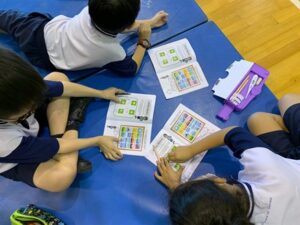
On Day 2, students had time to refresh their memories on what they learnt on the first day. This recap is essential as young children often need revision and repetition to solidify their foundation strong. Students learnt angle blocks which a few found difficult as it was their first time learning about angles. However, this value-add gave them a head start to their academic curriculum. Ending the program on a light note, the students created a song for the robot with the use of music blocks.
Positive Feedback from Teachers and Students
Overall, we received positive feedback from the teachers and students alike. The teachers were impressed by how a simple tactile programming platform could help add to the student’s growth in problem-solving, conceptual thinking and embed the values of teamwork in them.
The students enjoyed our coding program immensely! Many were curious to know more functions that were not covered during the short 2-day program. We are so encouraged by their response and privileged to be a part of their coding journey!
To find out more about our coding programs for schools, please contact us at hello@ripplecreate.com

P1 and P2 students learning coding through a screenless robotic platform.